Two points require some adjusting to counteract Western skew of facts:
1. "Iran during the reign of the Shah", to quote an Iranian who supported the Khomeini take over, "was paradise times ten thousand to what we live with under the Mullahs".
Corruption and suppression of political liberty in Iran at that time was no more than can be found in a "police" State like France or current political events in America, where power and influence are equally abused - specially by the Main Stream Media. The article below tarnishes the Shah somewhat unjustly while forgiving or ignoring the same or worse situations in Europe and the USA. "Bad, bad Shah! OK for us to do the same over here".
2. Secondly, availability of computers in the private sector inside Iran has only come to the fore in the past three years or so and under strict control of the Islamic Regime, which controls/"owns" all telephone and communications facilities and thus can switch the Internet on or off at will. While a limited number of PCs may exist in private hands, Servers required for networks , the Internet and Bloggers are not readily available except in government or quasi-government organizations.
"Ten hours of use cards" mainly at Internet Cafes cannot and does not provide facilities for a huge number of bloggers. As the "founder" of www.antimullah.com I know how much time and effort it takes to write and post. This being one of the reasons why I know a few minutes here and there are not a means to operate a blog. Specially when you have to earn a living to pay your bills and cannot devote enough time even in a free country like the USA. This article encountered some formatting challenges and required two and a half hours to post correctly.
Inside Iran there are neither five million regular users - as we would perceive it in America or Europe - nor hundreds of thousands of bloggers inside that country. If there were, Regime change would become much easier than it is now, since widespread communication facilities inside the country by outside opposition is almost non-existent.
One of the failings of analysts evaluating countries or territories within which they have not previously lived for decades, nor are now living inside there to adjust their ability to perceive current reality, becomes the tendency to see and conceive certain matters based on their own country or locality. Something as simple as "seeing" phone line availability based on AT & T or PacBell etc. or maybe a bad version of that. Far from the reality inside Iran.
Interaction with the worldwide Iranian expatriate community and a skin deep layer of similar thinking persons inside Iran, creates a separation from the fact that 99% of the Iranian "Joe Six-pack" is not even recognizable in those terms.
Including the students on whom so many count to move against the Regime yet forget that they have been so badly "trashed" by the Regime over the past decade and more so lately that few have any courage or energy left to do what needs to be done. Specially in the face of ever greater and forceful repression now that AhmadiNejad and his Revolutionary Guard commanders have taken over or wrested power from the more pragmatic Ayatollahs who have something to lose, whereas the neo-Iranian leaders have nothing, never did and will not miss much if the world crashes.
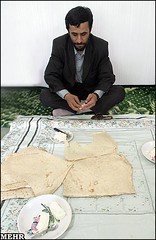
For example, the President of Iran, AhmadiNejad sits down to a meal. He and his colleagues can live and maintain the simple lives they have always lived even if the rest of the world goes up in flames or descends into hell. How hard is it to retain this level of life?
Analysts are blind to this fact and that some 80% of Iranians inside Iran live like this man. Again, including the students, journalists and free thinkers as a family. The other 20% are the richer Mullahs and Iranians who have lived overseas and may now be back inside Iran with enough money to have a lifestyle closer to that in the Western world. Many of these are nouveau riche clerics and their entourage who came from poverty and low class families and still do not have the sophistication analysts believe they may have when meeting expatriates.
 So far, the Los Angeles TV station that broadcasts a couple of hours a day and takes live calls from Iran, is perhaps one of the only effective ways of sharing information as radios do exist in large numbers and cell phones, limited though they may be compared to our use do not require landlines.
Only somewhat facetiously, one of the best ways to spend Congressionally approved budgets for promoting Democracy in Iran would be to get as many satellite and cell phones in there as possible with good links and the ability to call live into TV or radio stations.
Live announcements by phone callers of movements, gatherings, call to arms or anything else made over the phone to these external broadcasts by cell or satellite phones would be heard nationwide in Iran. Frequency changes or huge power transmitters across the Persian Gulf would prevent jamming by the Islamic regime.
All of a sudden, thus, we would be not only have a capability to "inform" but to "organize" and "put into motion".
Alan Peters
PATTERNS OF DISCONTENT: WILL HISTORY REPEAT IN IRAN?
By Patrick Clawson and Michael Rubin*
While international attention is focused on Iran's nuclear program and President Mimed Ahmadinejad's bombast, Iranian society itself is facing turbulent times. Increasingly, patterns are re-emerging that mirror events in the years before the Islamic revolution. These include political disillusionment, domestic protest, government failure to match public expectations of economic success, and labor unrest. Nevertheless, the Islamic regime has learned the lessons of the past and is determined not to repeat them, even as political discord crescendos. This essay is derived from the authors' recent book, Eternal Iran: Continuity and Chaos (Palgrave-Macmillan, 2005).
Mahmud Ahmadinejad's victory in Iran's 2005 Presidential elections shocked both Iranians and the West. "Winner in Iran calls for Unity; Reformists Reel," headlined The New York Times.[1] Most Western governments assumed that former President and Expediency Council chairman Ali Akbar Hashemi Rafsanjani would win.[2] Many academics also were surprised. Few paid any heed to the former blacksmith's son who rose to become mayor of Tehran. Brown University anthropologist William O. Beeman, for example, spent the election campaign in Tehran. In a June 15, 2005 interview with the Council on Foreign Relations, he called Rafsanjani the frontrunner and said the clerical establishment backed Muhammad Baqur Qalibaf.[3] He did not mention Ahmadinejad in his analysis, just two days before he won the first round. The Washington Post only mentioned Ahmadinejad once prior to the election.[4] The New York Times did little better, with just brief four mentions dating to Ahmadinejad's 2003 election as mayor of Tehran.
The election of Ahmadinejad was only the latest in a series of surprises that Iran has produced in recent decades. Indeed, a review of Iran's history over the last thirty years suggests that Iran excels at surprising its own people and the world. This does not mean that history will be repeated. But it is worth bearing in mind that nearly three decades after the shah's grip on power began to falter, there are once again deep strains between governed and government. That suggests a looming struggle between regime and people which is already unfolding quietly. Given Iran's track record at changing direction suddenly and unexpectedly, it would be unwise to assume that the Ahmadinejad government will rule smoothly. While Washington and most European capitals focus their attention on diplomacy surrounding Tehran's non-compliance with the Nuclear Non-Proliferation Treaty's safeguards agreement,[5] internally, the Islamic Republic is bubbling.
A REVOLUTION WHICH SHOCKED THE WORLD
The Islamic Revolution shook Iran to its foundations. Few observers, either inside or outside Iran, imagined a return to theocracy would be possible: In early 1978, Iran was striving to become like Europe; within a year, Ayatollah Ruhollah Khomeini was leading Iran down an entirely different path that rejected Western notions of modernity. The revolution was a massive event in several senses. For one, it appears to have been the most popular revolution in history in the sense that at least ten percent of the Iranian population participated, compared to little more than one percent for the 1776 American, 1789 French, or 1918 Russian revolutions.[6] Furthermore, it brought far-reaching changes to Iranian society, dramatically reversing the Western-style modernization which had been the central feature of Iranian life since the early years of Reza Shah's reign.
And the Iranian revolution also reverberated throughout the region if not the
world, stimulating destabilizing movements, catalyzing terrorism, and leading to one of the bloodiest wars of the post-World War II period. Iran's revolution was a remarkable event in many ways. It took nearly all foreign observers by surprise; equally, it took nearly all Iranians by surprise. While some historians have, with 20-20 hindsight, argued that the Islamic Revolution was a logical outcome of Iran's political evolution,[7] a sober analysis of what happened and why still leaves a dissatisfying sense that the causes remain not fully explained. Perhaps the best way to understand the 1979 Islamic Revolution is that it was indeed in part an anomaly.That the opposition to the Shah rallied behind the banner of Islam was the evolution's greatest surprise to the West. What had passed largely unnoticed over the previous decade was the coming together of the same coalition of reform-minded intellectuals and clerics that had been so central to both the 1906-11 Constitutional Revolution and to Prime Minister Muhammad Musaddiq's success.
The 1960s saw the growth of Islamic associations among intellectuals. In contrast to the devout urban poor or traditional middle classes, these intellectuals were less prone to accept the authority of the clerics and more attracted to ideology. Iranian opposition is often influenced by outside ideas. Isolation is not an Iranian political trait. The key figure in providing that ideology was Iran's "outstanding intellectual" of the 1960s, Ali Shariati.[8] While studying for his doctorate in sociology and Islamic studies in Paris, he translated Franz Fanon, "Che" Guevara, and Jean-Paul Sartre and was injured demonstrating against the Algerian war. Returning to Iran in 1965, he lectured at the Husseinieh-i Ershad, a Tehran religious meeting hall financed by the heirs of Musaddiq's movement.
Shariati's lectures were extraordinarily popular, circulating on cassette and in transcription. He was the most popular writer on Islam for pre-revolutionary young, urban Iranians, who thought that modernization might be consistent with traditional Islamic values. Prior to his sudden death in 1977, he made Islam hip, in no small part by his connecting Islam to Third Worldism infused with both political and cultural anti-Americanism. He also disassociated religion from the monopoly of the clerics. Not surprisingly, once in power, the Islamic Republic tried to counter his teachings. Nevertheless, his ideas have continued to have strong resonance within Iranian society.
While the clerical establishment hated Shariati, Khomeini took a neutral stance, being politically astute and well aware of Shariati's popularity. Presumably in
response to the enthusiasm for anti-Western Islam seen in the Shariati phenomenon, Khomeini began to use many Third Worldist phrases. Whereas his 1963 polemics against the Shah which led to his exile were in no small part directed against leftist reforms_land reform and women's suffrage_his discourse by the late 1970s made Islam sound compatible with Marxism. Ervand Abrahamian provides numerous examples: "The lower class is the salt of the earth;" "In a truly Islamic society, there will be no landless peasants;" "We are for Islam, not for capitalism and feudalism." [9]This marriage of Third Worldism with Islam was the potent mixture which let clerical activists take charge of the opposition to the shah. After the fact, the nsuccessful liberals argued that, rather than clever politics by the clerics, it was the shah's repression of liberals but tolerance of Muslim critics which was responsible for the clerical take-over of the opposition; in the words of the liberal first post-revolutionary prime minister Mehdi Bazargan, "In spite of the power of the security forces, the mosques and religious centers were sanctuaries."[10] That was by no means the case. In the 1970s, more than 600 religious scholars were arrested, exiled, tortured, or killed. In the last year of the monarchy, more than two dozen religious buildings were attacked by the police. Indeed, the clerics had fallen on hard times in the 1970s. In 1975, the Shah had sent gendarmes into the main theological college in Qom and destroyed most of the clerical colleges in Mashhad, traditionally at least as important a holy city as Qom, on the pretext of creating a green space around the shrine of the eighth Imam.[11] The clerics were unable to use the traditional escape route of fleeing to Iraq, where Saddam Hussein's government had by then so pressed the Shi'a learning centers of Najaf and Karbala that the number of scholars and students had fallen to 600. In their seizure of the leadership of the opposition, the clerics were aided by two factors: First, the liberal and leftist oppositions were not impressive.[12] The Tudeh (Communist) Party was a shadow of its former self, the New Left guerrilla groups never amounted to much, and the liberal National Front had by and large decided that it had to follow clerical leadership since the latter were better placed for mobilizing the populace.
Second, Khomeini was a charismatic and dedicated leader. He was not content to be politically quietist. Not only did he speak out about political issues, he
also devoted himself to the nitty-gritty of political organization. In particular, he for years devoted much energy to preaching, an activity usually left to the lowest-ranking clerics. In addition, his frequent popular sermons were much distributed by cassette. And he developed and articulated a clear ideology for clerical rule, something to which Shi'a clergy had never previously aspired.Besides being a dedicated political organizer and a bold political theorist, Khomeini had a commanding presence and led a personal life completely in line with his principles; for instance, whereas many other clerical activists become extraordinarily wealthy after the revolution, Khomeini lived a simple life and on his death had only a few meager possessions.
Understanding how the latent opposition to the shah turned into a revolution is rather like blind men making sense of the elephant: one's opinion depends on what part of the story one feels. The bare facts are subject to many interpretations. [13]Reflecting the conviction that external actors control Iran's destiny, much is often made of how Jimmy Carter made human rights a major issue during the 1976 U.S. presidential elections campaign.
To be sure, soon after Carter after assumed office, the shah allowed liberal
opposition groups to organize semi-public protest meetings. In November 1977, when the shah visited Washington, anti-shah protestors were militant enough to force the police to use tear gas which drifted across the street to the White House lawn, causing both the shah and President Carter's eyes to tear.
During the same weeks, commemorative services were held in several cities for Khomeini's eldest son and chief aide, for whose death many Iranians suspected the Shah's security service to be responsible. Despite a crackdown, Islamist used the annual religious processions, which that year fell on December 20-21, for political protest. All this activity was at quite a low level until a January 7, 1978, newspaper article hurled invective and accusations of homosexuality at Khomeini. Outraged, clerical students forced reluctant senior scholars to cancel classes and Qom merchants to shut the bazaar. When protests continued a second day, the police intervened, killing five. Iran was a tinderbox. The article provided a spark.
The killings began a cycle of protests every forty days on the arba'in, the traditional day of mourning on the fortieth day after death. Despite the effort of senior clerics to ensure that the arba'in was peaceful, events spun out of control in Tabriz. A major riot ensued. Forty days later, there were riots resulting in deaths in several cities, which in turn led to even more extensive protests forty days later. The cycle was broken only on June 17, when Islamist activists decided on a stay-at-home protest. It may have been prudent for them to back down given indications their supporters were growing tired.
The early 1978 political mobilization by clerical activists was quite an acomplishment. Contrary to the myth that they could draw on a mosque network to mobilize people, the clerical activists in fact had to forge contacts across the country in the face of considerable opposition from the senior clerics who controlled most mosques. The political activists--often exiled by the shah to small, out-of-the-way towns and villages--also had to radically transform the traditional arba'in from a quiet event for family and friends into a mass public protest.
As the summer of 1978 wore on, it looked like the protest movement had stopped growing. To be sure, clashes continued. Many Iranians blamed the death of hundreds in an arson attack on an Abadan cinema on the government, even though Islamist activists had been attacking symbols of Westernization such as cinemas and liquor stores. After the fire, the Shah reached out to the opposition, appointing a new "government of national reconciliation" which returned Iran to the Muslim calendar, closed casinos, legalized political parties, and invited Khomeini to return to Iran (he refused, so long as the shah was in power). It is interesting to speculate what would have happened had the liberal opposition wholeheartedly embraced this opportunity. Instead, the modern reformers thought they could make use of the popularity of religion, so they followed the lead of Khomeini in rejecting the new government's offer to negotiate. SUNY Stonybrook Professor Sa'id Arjomand wails, Why, instead of wringing concession after concession from a desperate shah and a frightened military elite, did they choose to become subordinate allies of a man who treated them with haughty contempt and rejected their principles of national sovereignty and democracy?
How can one account for the abject surrender to the clerical party of one after another of the feeble, middle-class based political factions: liberals, nationalists, and Stalinist communists alike? [14] Islamists seized the initiative. On September 4, 1979, they marked the end of Ramadan with a mass march in Tehran that grew to hundreds of thousands; the government had expected only a normal celebration.The militants followed this up with another mass protest three days later which turned into an extraordinary event. While it did not include the four million claimed by the opposition, even the shah's government was forced to acknowledge participation exceeded the hundreds of thousands who had turned out three days earlier. It was at this demonstration that was first popularized the slogan calling for an Islamic Republic.
The shah responded by imposing martial law on major cities, while leaving in place the reformist government. In theory, this could have been a clever combination of carrot and stick, but in practice it was inept and clumsy. The very first day of martial law, a demonstration at Tehran's Jaleh Square turned bloody. Rumors swept the country of thousands killed, though post-revolutionary investigations essentially confirmed the much lower figure of 87 dead. [15]
The shah's problem was that he had built a system centered on his person, in which all decisions required his approval and which he sustained with an extraordinary arrogance. But he did not have the character to confront serious challenges. He vacillated, a problem perhaps exacerbated by his fatal illness. He would not let his generals unleash a wave of repression. The limited crackdown he authorized only fed popular anger.
The shah's conciliatory offers-such as October statement that "if it could be useful, I would play a less active role"-were seen as signs of weakness,[16] in particular because Khomeini dramatically stepped up his profile and his rhetoric when, in another miscalculation, the shah requested his expulsion from Iraq. From France, Khomeini was readily accessible to international journalists and to visiting Iranians. Media and accessibility matter.
What sealed the shah's fate was the wave of strikes that spread from September. In late October, the oil workers walked out, threatening to bankrupt the government. By November, the banks were closed more often than they were open, creating chaos throughout the economy, and the ports were generally shut, slowing to a trickle the imports on which modern life depended. On December 11, 1978, on the Shi'a holy day of Ashura, millions turned out into the streets to demand the shah's departure. The shah left Iran on January 16, never to see his country again.
A REVOLUTION WAIVERS
Over the next twenty years, the Islamic Republic produced more than its fair share of surprises, not least of them being the prolongation of the war with Iraq and then eight years later its equally sudden end. A fuller examination of the Islamic Republic's rule would reinforce our general theme that its course has often changed direction suddenly and unexpectedly. But rather than heaping example on example, fast forward two decades: The Iranian public quickly spent its revolutionary fervor, as the economy faltered and the Iran-Iraq War devastated a generation. The baby boom that accompanied the revolution and war grew up. Perhaps half the population, if not more, was born or came of age entirely after Khomeini's return. Their understanding of life in pre-revolutionary Iran became based less on experience and more on perception. Forgotten are the corruption of society under the shah and the disparity between haves and have-nots. Remembered is the integration of Iran into the international community.
The 1997 presidential election turned both Iranian public and international expectations upside down. Most observers expected the establishment candidate Majlis speaker Ali Akbar Nateq-Nuri to win. After all, he had the tacit support of the Supreme Leader.[17] But obscure former culture minister and National Library head Muhammad Khatami had reached out to disaffected youth and had campaigned across the country. A storm of excitement swept the country.
Twenty-nine million people turned out to vote compared to 16 million four years earlier. Khatami's 20 million votes was a crushing victory. Of the 26 provinces, he carried 24. The 1997 election changed the image of the Iranian revolution, both at home and abroad. While radical Islam appeared to be gaining in popularity in many parts of the Muslim world, Iranians by the millions rejected it at the polls, instead casting their lot with reforms which seemed to have much in common with Western liberal ideals. It appeared that reform was the way of the future, because it was supported by the overwhelming majority of Iranians, especially the youth.The story of the eight-year Khatami presidency is how those high hopes were dashed. Even after they won control of the Majlis, reformists were unable to wrest power from the revolutionary institutions led by Supreme Leader Ali Khamene'i. Khatami may have won the title of president, but such titles do not come with the authority that they do in the West. Iran was still a theocracy, and Khamene'i remained an unelected Supreme Leader with unlimited veto power and ultimate control over Iran's security apparatus. When Khatami was elected, the near-universal expectation among Iranian youth and intellectuals, as well as Western observers and governments, was that reform was inevitably coming to Iran; the only question was how quickly. This is what shaped Western policy: how to reinforce Khatami and the reform cause. But in the end, Khatami's rule was as surprising as his initial election victory. Khatami's tenure surprised because it showed that even as many Iranians supported reform, a popular mandate was not enough to change the basic character of the Islamic Republic.
Regardless of Khatami's own sincerity, his first years in office were characterized by a confident reform movement chafing at what they saw as stalling actions by hardliners doomed to the dustbin of history.
The reform movement's initial sense that history was on their side was fed by their emergence from a marginal intellectual trend which grew into a powerful social force. The advocates of "alternative thought" (andisheh-ye digar) had appeared at the edges of the intellectual scene in the early 1990's, preparing the ground for the Khatami phenomenon by opening up the political scene to debate about freedom, respect for civil rights, and the relationship between religion and politics. One of the more significant figures was Abdul-Karim Soroush, who had been a devout supporter of hardline policies in the early revolutionary years and indeed had led the cultural revolution against Western influence in the university. His dense philosophical writings decrying the politicization of religion were popular among some younger clerics who believed that the close identification with the state was hurting Islam.
Soroush was harshly criticized by hard-liners and physically attacked by Ansar-i Hizballah vigilantes to the point that he had to refrain from speaking in public.
After Khatami's election, the intellectual debate about reform took off. The long-standing taboo against questioning clerical rule broke. Mohsen Kadivar openly attacked rule by the jurisprudent (velayat-e faqih), the foundation of clerical rule, as incompatible with the Qu'ran and Shi'a tradition as well as with democracy, which he strongly upheld as the best way to run society. In 1999, the hardline special clerical court, a little known institution within the Iranian theocracy, sent him to jail for eighteen months, but that only made him more popular. Grand Ayatollah Husayn Ali Montazeri-a political pariah since his 1989 dismissal as Khomeini's deputy--re-emerged at the edges of the political scene with harsh attacks on theocratic leaders and the principle of clerical rule. The revolutionaries hated him intensely and kept him under house arrest, but they did not dare do more to him, knowing he commanded great respect in society.
Khatami's victory did result in a relaxation of social restrictions. The Iranian government initially licensed more newspapers and publishing expanded. Throughout the early years of the revolution, booksellers tended only to republish classical works like Persian poetry, religious discourses, anti-Israeli and anti-American propaganda, and collections of historical documents without annotation. To publish anything original--or anything too analytical--could be dangerous since the tides of revolutionary fervor ebbed and flowed. But, in the brief Tehran spring, intellectuals took new chances with books, magazines, and films. The first cyber-caf? opened in 1998; access to the internet was highly prized as a window on the West.
The reformers turned politics upside down by taking disputes to the people, reminding hardliners at every opportunity that 20 million had given Khatami a mandate. The reformers were also skillful at redefining the political debate in ways that played to their advantage, for example, emphasizing the rule of law with its implicit contrast to the power of shadowy revolutionary groups.
In the face of popular enthusiasm for change, hardliners hit back by increasing persecution of religious and ethnic minorities, a populist tactic with long precedent in Iran. In late 1998, government agents raided more than 500 homes in which the Baha'i community had for more than a decade run the Baha'i Institute of Higher Education to provide college education for Baha'is who are banned from state universities; they confiscated materials used to teach subjects like dentistry and ccounting.[18] In early 1999, Iranian officials arrested thirteen Jews on accusations of espionage for Israel. There was little if any evidence and the ensuing international outcry forced the regime to back off on threats to execute them. The public relations crisis may have been just what the hardline security forces wanted, for it drove a wedge between Iran and the West and highlighted the hollowness of Khatami's power.
Limitations on the use of the Azeri language also increased, and treatment of Kurds deteriorated to the point that in 2001 all six Kurdish members of the Majlis resigned in protest. But outside of persecution of minorities, the hardliners had few initial successes. One group organized a string of murders of intellectual dissidents, most notoriously the November 1998 killing of Darius Foruhar and his wife; Foruhar was a rabid nationalist who had in the 1950's founded the Pan-Iranist Party, which was anti-shah, anti-clerical, anti-Arab, anti-Turk, and anti-Semitic.[19] It quickly became apparent that this was part of a campaign, which Iranians refer to as the "serial killings" of dissidents. In a break from the past pattern under the Islamic Republic, this repression by hardline vigilantes provoked outrage, resistance, and an official investigation by a committee appointed by Khatami. By January 1999, the
Intelligence Ministry had to admit it was involved in the serial killings; the minister resigned and twenty-seven intelligence ministry operatives were arrested. In June 1999, the ringleader, Sa'id Imami, reportedly committed suicide in prison, implausibly by drinking hair-removal cream in what was widely seen as a murder to prevent implication of higher ups.Hardliners had more success blocking reform through their continued control of many institutions. The Majlis still had a narrow majority of hardliners, so the
Khatami government had problems getting its initiatives funded or turned into law. To gain Majlis approval for his cabinet, Khatami had to put hardliners in many key posts, and the Majlis eventually forced out one of the most effective reformers, Interior Minister Abdullah Nuri (later imprisoned), and undermined another, Culture Minister Ayatollah Mohajerani.Even more troublesome was the judiciary, which was firmly in hardline hands. The most important barrier to reform was the unelected revolutionary parallel power structure. Within the Islamic Republic, normal institutions are matched by parallel revolutionary institutions. The Revolutionary Guards, for example, matched the army, but had access to better weaponry and facilities. Khatami might be president, but the office of the Supreme Leader had far greater power. The Revolutionary oundations controlled their own banks, subject to far less oversight and regulation than parallel state banks. After Khatami's election, the revolutionary institutions went on the offensive. When Revolutionary Guard Commander Yahya Rahim-Safavi was quoted as saying about the reformers, "Some of them should be beheaded or have their tongues torn out," Khamene'i did not reprimand him. [20]
In retrospect, the turning point at which the hardliners regained the initiative was the July 8, 1999 police and vigilante attack on a Tehran University dormitory whose students had protested press censorship.[21] Despite intense pressure from the regime, hundreds of thousands of protestors filled the streets, prepared for confrontation.
Khatami said nothing for two weeks and then issued a mild rebuke against those "who promoted the use of force against people of differing opinions."[22] He had no stomach for confrontation, and instead sought to preserve unity among the clergy. Police rounded up hundreds of students, some of whom remain in prison. No charges were ever filed against the vigilantes, many of which drove a type of motorcycle issued only to the Revolutionary Guards. Khatami's inaction exposed a gap in perception between the President and those who had elected him. While ordinary ranians wanted substantive reform and perhaps the end of theocracy, Khatami was dedicated to perfecting the Islamic Republic, not to replacing it. While many in the West saw him as a gentle reformist, at heart he was a product of the system and loathe to endanger it. He had nothing in common with those who wanted a secular government on the Western model. A lackluster economic situation only furthered public disillusionment. Unemployment mushroomed as more young people entered the job market. During Khatami's first term, the number of Iranians with a job rose by only two million while those of working age increased three times that.[23] As the extra four million baby boomers move into the labor market, Iran faces a serious unemployment problem. The usually sober and understated World Bank sums up the "daunting unemployment challenge" with strong words: "Unless the country moves quickly to a faster path of growth with employment, discontent and disenchantment could threaten its economic, social, and political system." [24]
Not all of this was his fault. Iran still suffered a foreign debt crisis, and the drop in oil prices hit Iran hard.
Different political factions all agreed the economy was in bad shape and that drastic teps were needed. But no one was willing to tackle the entrenched interests, be it the subsidies for consumer goods that drained the public coffers or the rampant corruption that enriched the politically well-connected but scared away foreign investors. [25]
While reformists still won a resounding victory in the 2000 Majlis elections, and Khatami won re-election the following year, divisions were increasingly apparent. Five million fewer Iranians voted for their president; many simply stayed home. Former president and Expediency Council chairman Rafsanjani failed to finish in the top thirty in Tehran and so did not win a seat. The judiciary closed more than twenty newspapers and journals. The supreme leader swatted down a parliamentary attempt to shield the press from future crackdowns.
Vigilantes returned with a vengeance, and judicial repression of reformers rose.[26] In March 2000, an intelligence ministry vigilante shot and paralyzed Sa'id Hajjarian, one of the most important reformist strategists. Also in early 2000, the judiciary imprisoned former intelligence agent-turned reformist reporter Akbar Ganji who had revealed that Rafsanjani had directed a secret committee to decide which dissidents to murder. On a hunger strike in 2005, Ganji smuggled letters from prison sharply condemning the Islamic Republic.[27] There were several days of riots in Khoramabad in August 2000 when authorities broke up the authorized annual meeting of the main national students' reformist group. Vigilantes, the judiciary, and security forces establishing a parallel system of prisons completely outside of any legal framework in which political activists were brutally tortured.
Students increasingly did not differentiate between hardliner and reformer.
Instead, they focused on regime versus dissident. Khatami's annual December appearances before university students grew increasingly contentious.[28] Already in 2001, he was greeted with chants "In Kabul, in Tehran, Down with the Taliban." In 2004, his televised presentation bordered on a riot, with most of the audience chanting "Khatami, what happened to your promised freedoms?" and "Students are wise, they detest Khatami," to which his response was, "I really believe in this system and the revolution."But rather than spur mass protest, much of the anger at failed or blocked reforms took the form of withdrawal from politics. Indeed, some reformers proposed a "Polish model" of withdrawing for a decade, based on their reading of how communism was brought down in Poland a decade after martial law displaced the Solidarity movement. If they did not participate in politics, then the revolutionary fringe would bear sole accountability for the Islamic Republic's failings. A key event emonstrating the extent of anger was the July 2002 resignation letter of Isfahan Friday prayer leader Ayatollah Jalaluddin Taheri, a respected revolutionary known for his reform sympathies, which blasted the elite for its corrupt kingly life style and denounced the shadowy vigilante groups for disgracing the revolution. Taheri had carried special status since he had been appointed directly by Khomeini.
A fascinating source of information about popular attitudes is the public opinion polls conducted by the government. In 2001, the Islamic Guidance and Culture Ministry published a detailed series of polls of 16,274 people.[29] Asked to choose between "support of the current situation, correction of the current situation, or fundamental change from the core," 11 percent took the current situation, 66 percent correction, and 23 percent fundamental change-although that result should be read in light of the 48 percent who said "no" when asked "could Iranians criticize the current regime without feeling scared or threatened." When the Majlis commissioned a similar poll in 2002 which found that 74 percent of Iranians favored resumption of relations with the United States and 46 percent felt that U.S. policies about Iran were "to some extent correct," the pollsters were sentenced to at least eight years in jail. Not surprisingly, polling has dropped off since. However, professional telephone surveys conducted from Los Angeles indicate that no more than one-quarter of Iranians favor the current system of government.[30] The souring mood was evident in a series of domestic upheavals. In 2001, a series of riots broke out after a disastrous Iranian performance in the soccer World Cup. The protests evidently started when Los Angeles-based exile television suggested that the Iranian government had ordered the national team to throw a game so that women and men would not party in the street.
There was another wave of student demonstrations in June 2003. While the
hardliners are top on in Iran in 2005, strong social trends work against their
continued control. The two most powerful social forces in Iran are globalization and the problems of the baby boom generation born just after the revolution.Both these trends work against the hardliners' control. There is a potentially
explosive mixture of a cultural elite hostile to the ruling political class plus a frustrated and despairing youth with no connection to society. While much of the Muslim world seems ambivalent at best about globalization, Iranians have sought greater contact with the outside world, especially the United States. By contrast, the hardliners fear what they perceive as a Western cultural offensive undermining Islamic Iran's values.In addition to satellite television, another popular way to evade the strict official censorship is the internet. Use of the internet has exploded in recent years, fueled both by technology and by the hardline closure of reform newspapers. By mid-2004, five million Iranians used the Internet.[31] A card offering ten hours of use with one of the 660 Internet service providers typically costs a few dollars and can be bought at most small stores and newspaper kiosks. Faced with an estimated 100,000 weblogs, hardliners stepped up their political pressure on internet users in 2004. Political censorship had been a fact of life since the 2001 requirement that ISPs and internet cafes institute government-mandated controls--most of the 10,000 sites blocked in Iran were political, not pornographic _ but that could be evaded by the technologically savvy.
So in 2004 the hardliners pushed through laws covering "cyber crimes" and began arresting those running political sites. [32] And there is yet a third labor challenge, namely, women. According to Iranian government census data, in 1996, Iran had 1.8 million working women compared to 13.1 million women home-makers. In 2000, for the first time, more women than men were admitted to universities. The trend has since accelerated.
International experience suggests that as women's educational standards improve, more women will want jobs. If the percent of women who want jobs rises from 15 percent to 25 percent--the current rate in Tunisia, and if GDP grows only at its recent average 4.5 percent a year, then unemployment will reach 23 percent in 2010, even assuming state enterprises remain grossly overstaffed. There is little indication that the political elites are willing to undertake the reforms needed to make effective use of the country's labor potential. The extra resources from the oil boom have not to date been used for job-creating investments; little is being done to promote a more favorable environment for private sector development; and the difficulties women facing in private sector employment remain unaddressed. It would seem that instead of making reforms the political elite is more comfortable with the "solution" of rising emigration rates, especially among the well educated.
Meanwhile, economic and political frustration is feeding social problems. The government acknowledges that two million people use narcotics, mainly opium; other estimates are higher.[33] Prostitution is also increasing; the official estimate is that there are now 300,000 prostitutes. There have been a number of corruption scandals involving judges and government social workers involved in prostituting young girls. With intravenous drug use and prostitution rising, Iran is vulnerable to a serious AIDS problem; the disease has become well established in the country. In sum, many of Iran's best and brightest are leaving the country, and a growing number of those remaining are at risk of becoming an underclass. These twin trends are undermining the Islamic Republic's claim to be promoting social equity.
BACK TO THE FUTURE?
So where does Iran stand now? Parallels do exist between some aspects of Iran in the years before the Islamicrevolution and the discord within the Islamic Republic today. Then and now, the Iranian public is largely disillusioned and detached from its leadership. Just as they did in the late 1970s, ordinary Iranians today grumble about the corruption of senior regime officials. High oil prices have brought the allegiance of a close coterie of aides and officials, but oil income has not won the loyalty of the population at large. Unemployment is a problem, as is disparity between rich and poor, privileged and disenfranchised. Simply put, too few Iranians see the fruits of Iran's natural wealth.
Neither the shah nor the supreme leader was or is able to gain hold of communications. In the 1970s, the shah failed to shut down the proliferation of easily duplicated audiotapes. Today, the supreme leader is waging a losing battle to contain the internet and satellite television. Iraq's liberation and the new accessibility of free media to hundreds of thousands of Iranian pilgrims visiting the Iraqi holy cities have raised the Iranian regime's anxiety.
Supporters of the Islamic Republic rightly point out that education has expanded since the Islamic revolution. New schools and universities have opened in areas far outside the major cities. But, just as under the shah, high schools and universities have again become Petri dishes for opposition. While before the Islamic revolution, students and police clashed at Aryamehr University, in recent years, Tehran University has become a center for protest.
Both the Shah and the Supreme Leader have sought to counter-protest using vigilante groups. On November 22, 1977, for example, vigilantes attacked an Id-i Ghorban meeting of nearly 1,000 Iranians near Tehran. The heavy-handed
tactics against religious Iranians did much to sour the public mood.Two decades after the Islamic Revolution, pro-regime vigilantes shocked
Iranian society with attacks on prominent intellectuals and dissidents. And, indeed, it was the Ansar-i Hizballah vigilante group which was responsible for the 1999 protests. That any Iranian government needs to utilize vigilantes to advance its policies suggests the breakdown of normal systems of governance and also suggests that popular attitudes prevent the political leadership from achieve their aims through overt politics.
Struggles between center and periphery are also characteristic of Iranian society at times of popular disaffection and government weakness. In February 1978, for example, civil disturbances in Tabriz grew so severe that the shah sent in the army to restore calm.The August 1979 arson attack on an Abadan cinema was a watershed event, the
Iranian equivalent of the Reichstag fire. Today, Abadan's home province of
Khuzistan is again a center for discontent, with riots over everything from
clean drinking water to housing shortages and agricultural shortfalls.[34] Residents complain that the Islamic regime in Tehran has mismanaged reconstruction in towns and cities pulverized during the Iran-Iraq War. The past year saw bloody demonstrations and attacks on government-owned buildings. In the riots' aftermath, Iranian authorities arrested more than 300 protestors, some of whom security forces summarily executed.[35] And then in February, three bombs went off in the center of the provincial capital Ahvaz at just the time Ahmadinejad was supposed to be speaking nearby, though he had cancelled his trip the day before on a flimsy excuse. Nor is Khuzistan alone in this regard. A wave of terrorist bombings struck the southeastern province of Baluchistan in October 2000 and again in June 2005; intriguingly, Ahmadinejad's bodyguards were killed when he visited the province in late 2005 (he had by then left for Tehran).[36] And rioting in Kurdistan in late 2005 resulted in at least eight deaths, including those of at least two policemen.
Labor unrest is also boiling. It was national strikes in key industries--oil, telecommunications, and banking--which finally brought down the shah's government. In recent years, the Islamic Republic has again had to face labor discontent. Textile workers in Isfahan, teachers in Tehran and, in January 2006, bus drivers have walked out on strike.[37] While workers complain about unpaid wages and high-level corruption, though, the labor unrest is not as widespread as it once
was.Given the lack of strike absent funds to help support workers' families, wildcat
strikes are likely to spread to key industries such oil and manufacturing. The
same economic discontent which brought Ahmadinezhad to power now threatens him since, despite the high oil income, he has not been able to deliver on his populist promises- his response has been to make many new promises for development projects as he tours the country, but there simply is not the money to pay for the projects he is promising.Indeed, while there may be parallels, the Islamic Republic has learned from the shah's mistakes. Carter's pronouncements encouraged opposition to the shah. George W. Bush has used his bully pulpit to good effect: The willingness of Iranians to protest openly can be correlated directly to the moral clarity of Bush's calls for democracy and human rights in Iran. However, Khamene'i will not cede the field of rhetoric to the White House. U.S. government pronouncements about Iran come only every few months. The Islamic Republic's state-controlled media use the intervening time to reframe Washington's statements, usually portraying them as threatening so that Tehran can rally Iranians around the nationalist flag.
The Islamic Republic may be a tinderbox but the Iranian government has learned to control the fires. Not all anger leads to revolution. They are determined not to repeat the Shah's mistakes. They want no Jaleh Squares or arba'in cycles. Relatively small events can snowball. Rather than confront protestors directly, security forces focus first on containment, followed subsequently by arrests interspersed over the following day and weeks. The tactic has proven effective.
Personality also matters. Khomeini was a charismatic figure able to unite--at least initially--liberals, nationalists, and clergy. Today, the opposition in Iran is
fragmented. There is no natural single leader. This does not mean that one will not emerge. Just as Islamists and liberals looked at imprisonment as a badge of honor during the latter years of the shah, so too do an increasing number of dissidents--including many former Islamic Republic officials. Dissident writer and hunger striker Akbar Ganji captivated the public when, in June 2005, he wrote, "I have become a symbol of justice in the face of tyranny, my emaciated body exposing the contradictions of a government where justice and tyranny have been reversed."[38]
Will Iran experience another revolution? It remains uncertain. But Iranian society is bubbling, and the stakes huge. However, whether defending the Islamic Revolution or seeking to undermine it, Iranians are taking note of the lessons of the past while they chart their future.
*Patrick Clawson is deputy director of the Washington Institute for Near East Policy.
*Michael Rubin is a resident scholar at the American Enterprise Institute. Between 2002 and 2004, he was country director for Iran and Iraq in the Office of the Secretary of Defense.They are respectively chief editor and senior editor of the Middle East Quarterly.
*This essay is derived from the authors' recent book, Eternal Iran: Continuity and Chaos (Palgrave, 2005), and has been reproduced with permission of Palgrave Macmillan. For more information and to order, see: http://gloria.idc.ac.il/publications/books/internaliran.htm
NOTES
[1] June 26, 2005.
[2] Robin Wright, "U.S. and Europe Gird for Hard Line from Iran's New President," The Washington Post, June 26, 2005.
[3] "Q&A: William Beeman on Iran's Election," The New York Times, June 16, 2005, http://www.nytimes.com/cfr/international/slot2_061605.html?_r=1&oref=slogin.
[4] Karl Vick, "Iranian Clerics Urge Big Turnout in Leadership Vote," The Washington Post, June 4, 2005.
[5] "Implementation of the NPT Safeguards Agreement in the Islamic Republic of Iran," IAEA Board of Governors, GOV/2005/77, September 24, 2005.
[6] Charles Kurzman, The Unthinkable Revolution in Iran (Cambridge: Harvard University Press, 2004), p. 121.
[7] See, for example, Nikki Keddie, Modern Iran (New Haven: Yale University Press, 2003).
[8] Ervand Abrahamian, Iran Between Two Revolutions (Princeton: Princeton University Press, 1982), p. 464. See also Ali Shariati, Marxism and Other Western Fallacies, translated by Richard Campbell (Berkeley: Mizan Press, 1980).
[9] Ervand Abrahamian, The Iranian Mojahedin (New Haven: Yale University Press, 1989), p. 22.
[10] Kurzman, Unthinkable Revolution, p. 39.
[11] Amir Arjomand, The Turban for the Crown (New York, Oxford University Press, 1988), p. 86.
[12] Cf. the sympathetic account of those political parties in Abrahamian, Between Two Revolutions, pp. 450-95.
[13] The most detailed chronological account of 1977-85 is David Menashri, Iran: A Decade of War and Revolution (New York: Holmes and Meier, 1990). Kurzman, Unthinkable Revolution, adds important information from the wealth of material which became available after Menashri wrote.
[14] Arjomand, The Turban for the Crown, p. 109.
[15] Kurzman, Unthinkable Revolution, pp. 37, 46, 71, 75, 109, and 176-77. The imperial government's official death toll for September 8 is cited in Dilip Hiro, Iran Under the Ayatollahs (London: Routledge and Kegan Paul, 1985), pp. 77 and 378. Hiro claims that the actual death toll in demonstrations that week was 4,000--good reflection of the accuracy of his account of developments during the revolution.
[16] David Menashri, Iran: A Decade of War and Revolution (New York: Holmes and Meier, 1990), p. 54.
[17] Voting data for 1997 and previous presidential elections are in Wilfried Buchta, Who Rules Iran? (Washington: Washington Institute for Near East Policy and the Konrad Adenauer Stiftung, 2000), pp. 34-37. The Khatami election campaign is described in detail in Ali Ansari, Iran, Islam and Democracy: The Politics of Managing Change (London: The Royal Institute of International Affairs, 2000), pp. 94-109.
[18] Firuz Kazemzadeh, "The Baha'is in Iran: Twenty Years of Repression," Social Research, Vol. 67, No. 2 (Summer 2000), pp. 546-47. On the arrests of Jews, see Ariel Ahram, "Jewish _Spies' on Trial: A Window on Human Rights and Minority Treatments in Iran," Research Notes No. 7 from The Washington Institute for Near East Policy, 1999. On the situation of Kurds and Azeris, see Maurice Copithorne, "Report on the situation of human rights in Iran," UN Commission on Human Rights Report E/CN.4/2002/42, January 16, 2002, pp. 18-19 and 25-26.
[19] On the serial killings, see Michael Rubin, Into the Shadows: Radical Vigilantes in Khatami's Iran (Washington: The Washington Institute for Near East Policy, 2001), pp. 89-94.
[20] Buchta, Who Rules Iran?, p. 143.
[21] On the July 1999 protests, the definitive work is the collection of articles from every major political camp in Iran in Mahmud Ali Zekriayi, Hejdehom-e Tir Mah 78 be Revayat-e Jenahha-ye Siyasi, Tehran: Entesharat Kavir, 1378 (2000).
[22] Buchta, Who Rules Iran?, p. 191.
[23] According to the IMF reports (p. 104 of the 2001 report and p. 23 of the 2004 report), the population aged 15-54 went from 30.85 million in 1996 to 36.52 million in 2001, while those employed went from 14.57 million to 16.44 million (and that was an upward revision from the 15.63 million jobs in 2000/01 estimated in the IMF's 2003 report).
[24] World Bank, Converting Oil Wealth to Development, p ii; 13-25.
[25] IMF, Recent Economic Developments, p. 51. The World Bank's evaluation of the Plan, on p. 7 of Converting Oil Wealth to Development, is harsher.
[26] On the serial killings Amadaldin Baqi, Tragedi-yeh Democrasi dar Iran: Bazikhoani-ye Qatelha-ye Zanjiri, Tehran: Nashrani, 1378 (1999/2000). On the parallel prisons, see Human Rights Watch, "Like the Dead in Their Coffins:" Torture, Detention, and the Crushing of Dissent in Iran, June 2004. See also Maurice Copithorne, "Report on the situation of human rights in the Islamic Republic of Iran," UN Commission on Human Rights Report E/CN.4/2001/39, January 16, 2001, especially pp. 7-8 on students and pp. 19-20 on the Berlin Conference aftermath; Rubin, Radical Vigilantes, pp. 96-107; and, on Ganji, Afshari, Human Rights, pp. 212-215.
[27] Sana Nourani. "Akbar Ganji: Justice in the Face of Tyranny," Middle East Quarterly (Winter 2006), http://www.meforum.org/article/891
[28] See Joe Klein, "Shadowland: Who's winning the fight for Iran's future?," The New Yorker, and Parisa Hafezi, "Iranian students heckle Khatami," Reuters, December 6, 2004.
[29] Nazgoul Ashouri, "Polling in Iran: Surprising Questions," PolicyWatch No. 757 from The Washington Institute for Near East Policy, May 14, 2003.
[30] Iran Institute for Democracy. "Iran Survey," June 2005.
[31] Middle East Economic Digest, "Special Report: Iran and IT," June 25, 2004. See also Michael Theodolou, "Iran's Hard-Liners Turn a Censorious Eye on Web Journalists," Christian Science Monitor, October 28, 2004; and Reporters Without Borders, "Internet under Surveillance 2004: Iran," June 22, 2004.
[32] Rachel Hoff, "Dissident Watch: Arash Sigarchi," Middle East Quarterly (Autumn 2005), p. 96, http://www.meforum.org/article/792
[33] For the official estimate of drug use, see "Iran has 1.2 million hooked drug addicts: official," http://www.payvand.com/news/03/jun/1161.html;; for other estimates, see Golnaz Esfandiari, "New Ways Considered For Tackling Growing Drug Use Among Young People in Iran," htp://www.payvand.com/news/03/dec/1023.html.
On prostitution, see Islamic Republic News Agency, "Iran juggles with taboos,
holds first session of prostitutes and police," http://www.payvand.com/news/02/dec/1032.html
[34] Bill Samii, "Emergency in Khuzestan," RFE/RL Iran Report, November 6, 2000.
[35] Bill Samii, "Fallout from Ahvaz Unrest Could Lead to Televised Confessions," RFE/RL Iran Report, April 25, 2005; Islamic Republic News Agency, June 14, 2005; Islamic Republic News Agency, October 16, 2005.
[36] Voice of the Islamic Republic of Iran radio, October 17, 2000; "Explosions Reported in Southeastern Iran," Associated Press, June 14, 2005.
[37] International Confederation of Free Trade Unionists, "Iran: Hundreds Arrested as persecution of trade Unionists Escalates," February 2, 2006, http://www.icftu.org/displaydocument.asp?Index=991223376&Language=EN
[38] Rachel Hoff, "Dissident Watch: Arash Sigarchi," Middle East
Quarterly (Autumn 2005), p. 96, http://www.meforum.org/article/792.
